Queer Places:
Eton College, Windsor SL4 6DW, United Kingdom
University of Cambridge, 4 Mill Ln, Cambridge CB2 1RZ
Harrow School, 5 High St, Harrow HA1 3HP, United Kingdom
Sherborne School, WFWM+X3, Abbey Rd, Sherborne DT9 3AP, United Kingdom
All Saints Churchyard, Church St, Rothbury, Morpeth NE65 7UP, United Kingdom
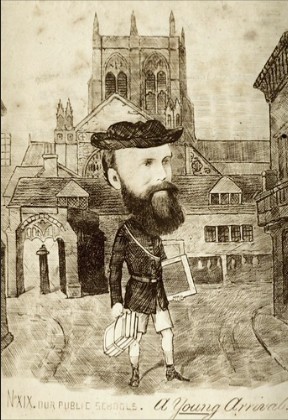 Edward Mallet Young (January 24, 1839 – December 19, 1900) was a prominent Victorian clergyman, classicist, and educator whose life intertwined elite academic achievement,
significant contributions to public school architecture and tradition, and a notable membership in the intellectual network of the
Cambridge Apostles.
Edward Mallet Young (January 24, 1839 – December 19, 1900) was a prominent Victorian clergyman, classicist, and educator whose life intertwined elite academic achievement,
significant contributions to public school architecture and tradition, and a notable membership in the intellectual network of the
Cambridge Apostles.
Born on January 24, 1839, at Formosa, Cookham, Berkshire, he was the second son of Captain Sir George Young, 2nd Baronet, and Susan Mackworth-Praed, daughter of William
Mackworth-Praed, and numbered the poet of the same name among his relations.
Young received his early education at Eton College before being admitted to Trinity College, Cambridge, on April 13, 1858. His undergraduate years were marked by
exceptional scholarly distinction. In 1860, he won the Browne Medal for a Latin ode on the fate of Franklin and captured the College English Declamation Cup. Following a
severe and dangerous illness in 1861 that temporarily interrupted his studies, he recovered to graduate as 7th Classic in the First Class of the Classical Tripos in 1863,
earning his Bachelor of Arts degree. He subsequently secured a prestigious Fellowship at Trinity College in 1865 and proceeded to his Master of Arts in 1866. During his
early scholarly and tutoring years, he served as a private tutor to Lord Beaumont at Eton and acted as Latin tutor to Prince Leopold, Duke of Albany, during the winter of
1862 to 1863, before launching into a grand tour of Egypt, Arabia, and Syria.
Beyond his formal academic pursuits, Young was a member of the Cambridge Apostles, the exclusive and intellectually rigorous secret society officially known as the
Cambridge Conversazione Society. While the Apostles are frequently associated in Victorian and Edwardian history with homsocial and homoerotic networks—most famously
producing figures later linked to the Bloomsbury Group and intelligence circles—Young's direct place within these currents reflects the elite, high-intellect culture of
mid-century Cambridge. His life also intersected with the traditional ecclesiastical path of high-achieving Oxbridge clerics; he was ordained a deacon in London in 1868 and
a priest in 1871, serving as a Select Preacher at Cambridge between 1876 and 1879, and again in 1890.
Young's professional career in education began at Harrow School, where he served as an assistant master from 1864 to 1878. As composition master to the sixth form, he
worked alongside notable figures such as Dr. Westcott, Professor H. Nettleship, and G.W. Hallam, and is credited with introducing the game of Fives to the school alongside
taking over Archdeacon Farrar's boarding house and pupil-room in 1868. In 1878, Young transitioned to a major leadership role when he was appointed Headmaster of
Sherborne School in Dorset, succeeding H.D. Harper.
Over a fourteen-year tenure at Sherborne ending in 1892, Young left an indelible mark on the institution's physical landscape and traditions. Emulating his predecessor's
zeal for building and restoration, he oversaw the creation of the West Cloister, the conversion of the old schoolroom into a library, the addition of classrooms, an organ
gallery, a gymnasium, a sanatorium, and the expansion of playing fields. Culturally, he instituted Commemoration Day in 1887, wrote the words for the school song Carmen
Saeculare, fostered a school orchestra, compiled a dedicated hymn book, and founded the school's glee competition and rifle corps.
Despite his architectural and ceremonial successes, Young's final years at Sherborne were clouded by controversy and friction. In November 1889, a damaging libel action
was brought against him by a former Sherborne assistant master, Edward Charles Malan. Heard in camera before Mr. Justice Denman in the Queen's Bench, the case resulted in an
adverse judgment and financial damages against Young when concluded in early 1890. This public scandal severely impacted the school's reputation and led to a marked decline
in pupil enrollment, ultimately contributing to his departure from Sherborne in 1892.
Following his retirement from headmastering, Young transitioned fully into high-ranking church service. He lived in Warminster for two years, served as a Canon of
Salisbury from 1890 to 1894, and took up the position of Rector of Rothbury in Northumberland from 1894 until his death. He also acted as an Examining Chaplain to the Bishop
of Newcastle and was appointed an Honorary Canon of Newcastle in 1897. On August 15, 1882, Young had married Augusta Melita Stephenson, the daughter of General Sir Augustus
Spencer and widow of Lieutenant-Colonel Sussex Vane Stephenson. The marriage produced no children, leaving him with no direct descendants.
Young died on December 19, 1900, at Coolings Hotel on Albemarle Street in London, where he had traveled to seek specialized medical treatment for asthma. He was buried on
December 22, 1900, in the churchyard of All Saints Church in Rothbury, close to the chancel door, where a memorial window in the eastern lancet of the south wall
commemorates his life. In his final testament, he bequeathed the Little Field to Sherborne School, cementing a legacy defined by profound academic brilliance, institutional
dedication, and complex administrative trials.
References:
Other references:
- Boase's Modern English Biography (Volume III, column 1573)
- Crockford's Clerical Directory
- The Guardian (Issue of August 23, 1882)
- The Times (Obituary notice, December 20, 1900)
- Alumni Cantabrigienses (Trinity College Admissions records, April 13, 1858)
- The Sherborne Register, 1823–1892 (Compiled by H.H. House, detailing administrative and staff records)
Support this project
This website is a passion project researched, developed, and funded entirely by me. If you find the content valuable and would like to help support the ongoing research and hosting costs, any contribution is deeply appreciated.
Thank you for keeping this independent resource alive!
My books on Amazon: Elisa Rolle's books
BACK TO HOME PAGE
